
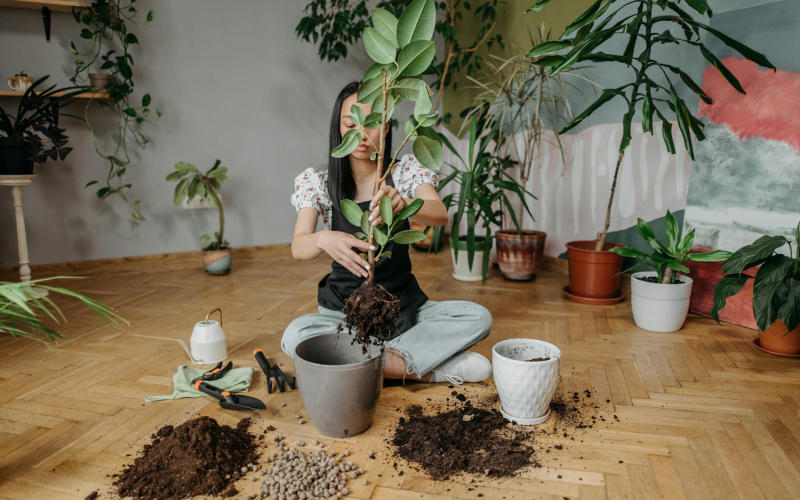

Most repotting guides hand you a list of 10 tools and a vague warning about “transplant shock” — and then leave you staring at your root-bound pothos wondering if today is actually a good day to do this. It never feels like the right day. That’s the paralysis talking.
Here’s what I’ve found after killing a few plants the wrong way: repotting doesn’t need to be a production. You need three tools, roughly 25 minutes, and a clear sense of what you’re actually trying to accomplish. Everything else is noise.
How to Know Your Plant Actually Needs Repotting
Not every plant that looks cramped is in trouble. Roots creeping through the drainage hole, water running straight through the pot without absorbing, or soil drying out within a day of watering — those are real distress signals. A pot that just looks “full” from the top? That’s often fine.
Worth knowing: Gardening Know How published a piece in April 2026 specifically calling out plants that prefer being root-bound — peace lilies, snake plants, ZZ plants, spider plants. Give a peace lily too much pot space and it stops flowering entirely, just pushes out leaves. So before you repot, make sure you’re not solving a problem that doesn’t exist.
Most houseplants need repotting every 12 to 18 months, according to The Sill, but slow growers can go much longer with just a soil refresh. same pot, new soil, no trauma. That distinction matters and most articles skip it completely.
The Only 3 Tools You Actually Need
Forget the elaborate setup. Here’s your minimum viable toolkit.
First, a Hori Hori knife. Nicole Forbes, Master Horticulturalist at Dennis’ 7 Dees, highlighted this tool specifically in their Spring 2026 repotting guide, it loosens root-bound plants from ceramic and terracotta pots without you having to yank on the stem, which is how stems snap. Run the blade around the inner edge of the pot, and the root ball slides out cleanly.
Second, pruning shears. Fiskars Micro-Tip Pruning Snips work well here. You’ll use these to trim any circling roots, dead roots, or roots that have fused around the drainage holes. Don’t skip this step if roots are matted. trimming them encourages new growth outward into the fresh soil.
Third, a bag of quality indoor potting mix. Miracle-Gro Indoor Potting Mix ($8–$10 for a 6 qt. bag) is practical: it feeds for up to 6 months, uses coconut coir, and is specifically formulated without compost or bark to resist fungus gnats. If you prefer a living-soil approach, FoxFarm Happy Frog is worth the higher price per quart.
That’s it. Trowels, misting bottles, chopsticks for aeration, all optional.
Choosing the Right Pot Size (This Is Where Most People Go Wrong)
The instinct to give your plant “more room” by jumping several pot sizes up is genuinely one of the most common repotting mistakes. Oversized pots hold excess soil that roots can’t absorb moisture from fast enough, and that soggy excess creates perfect conditions for root rot.
The actual rule: go 1–2 inches larger in diameter for small plants, 3–4 inches for larger floor plants. Nothing more. Penn State Extension Master Gardener Susan Marquesen reinforced this in their updated February 2026 repotting resource. the step-up sizing guidance is consistent across every credible horticulture source I’ve seen.
Also think about pot material. Terracotta wicks moisture actively, which is great for snake plants, succulents, and cacti that prefer drying out between waterings. Plastic retains moisture longer, making it the smarter choice for tropicals like pothos, ferns, and anthuriums. This single choice can determine whether your plant thrives or slowly rots post-repot, and almost no beginner guide mentions it.
The 25-Minute Repotting Process, Step by Step
Minutes 0–5: Water your plant lightly the day before. Not soaking wet, just damp enough that the root ball holds its shape when removed. Dry soil crumbles and takes root hairs with it.
Minutes 5–10: Run your Hori Hori around the inside edge of the pot. Tilt the plant sideways, support the base of the stem with one hand, and ease the root ball out. If roots have grown through drainage holes, cut them with your pruning shears rather than pulling. Pulling tears the root system.
Minutes 10–18: Gently loosen the outer roots with your fingers. not aggressive raking, just enough to encourage them to grow outward. Trim any dead, mushy, or tightly circling roots. Here’s what you should not do: wash all the old soil off. Robert Pavlis, who owns a 6-acre private botanical garden with over 3,000 species and has addressed this myth directly, confirms that washing destroys microscopic root hairs responsible for most water and nutrient absorption. Leave the interior root ball largely intact.
Minutes 18–25: Add a layer of fresh potting mix to the new pot’s base. Set your plant in, the top of the root ball should sit about an inch below the pot rim. Fill around the sides, press lightly to eliminate air pockets, water thoroughly until it drains from the bottom, and you’re done.
The Post-Repot Care Protocol Nobody Spells Out
Here’s where plants die after a perfectly executed repot: the recovery window. Most people immediately move the plant to brighter light or, worse, fertilize it “to help it recover.”
Don’t. Penn State Extension is direct on this: fertilizing near freshly repotted roots causes salt buildup, root burn, and sometimes complete root dieback. Your new potting mix already contains nutrients. Miracle-Gro Indoor Potting Mix feeds for up to six months on its own. The recommended wait before any fertilizer is 4–6 weeks minimum, and only after you see new growth.
Move the plant to slightly lower light than usual for the first two weeks. Water normally but don’t overdo it, the fresh soil holds moisture well. Some wilting or leaf drop in the first few days is normal. That’s transplant shock, not death.
What I’d Actually Do
Honestly, the advice I wish someone had given me earlier: before you repot anything, ask whether a soil refresh would be enough. Pull the plant out, check the root ball. if roots aren’t aggressively circling or escaping, just shake off the top inch or two of old soil, put it back in the same pot, and top it up with fresh mix. No trauma, no size decision, no recovery period.
And if repotting is genuinely needed, do it in March or April. Root growth accelerates up to 40% in spring compared to winter dormancy, according to LeafyPixels’ July 2025 research roundup, your plant will establish in the new pot dramatically faster during that window than at any other time of year.
FAQ
What if my plant’s roots are fused through the drainage holes?
Cut them with your pruning shears. don’t pull. Pulling tears the root system from the inside out. Once cut, ease the root ball out using a Hori Hori knife along the pot’s inner edge. Soaking the pot base in water for 10 minutes first can also loosen roots slightly before you cut.
Should I repot a plant I just bought?
No. Leave it alone for at least 6 months to a year. The greenhouse soil it came in is optimized for that specific plant, and repotting immediately adds stress to a plant already adjusting to your home’s light and humidity conditions.
Can I use garden soil from outside instead of potting mix?
Don’t. Garden soil compacts hard inside containers, blocks airflow to roots, and frequently carries pests, weed seeds, and disease. Always use an indoor potting mix specifically formulated for containers.
My plant keeps wilting days after repotting.
Is it dying?
Probably not. Mild wilting and some leaf drop in the first 5–7 days is normal transplant shock. Keep it in lower light, water normally, skip the fertilizer, and give it two full weeks before panicking. New growth is your green light that recovery is underway.
Photo by ROCKETMANN TEAM on Pexels