
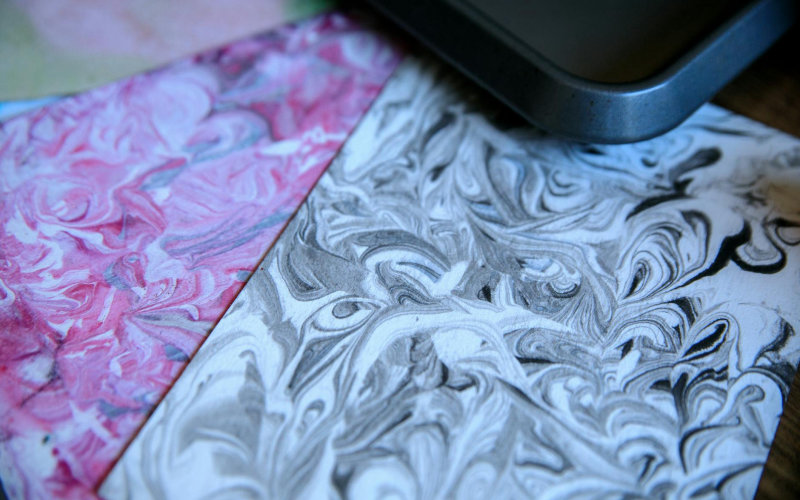

I ruined a lot of paper before I figured this out.
Back in 2019, I kept seeing those gorgeous swirled papers all over Pinterest and assumed they required some expensive marbling kit or Turkish ebru supplies shipped from overseas. Tried three different “easy” tutorials. All three produced sad, blotchy messes that looked nothing like the elegant swirls in the photos. The problem wasn’t the technique — it was that every tutorial skipped the parts that actually matter.
So here’s the real deal on marbled paper making at home, with all the frustrating little details included.
What You’ll Actually Need (No Fancy Supplies)
This is one of those crafts where the materials list is genuinely short. Shaving cream (foam, not gel — this matters enormously), food coloring, a baking sheet or shallow tray, paper, a toothpick or skewer, and something straight-edged for scraping, like a ruler or an old credit card. That’s it.
Paper choice is where most beginners go wrong. Cardstock works better than regular printer paper because it’s sturdier and absorbs color more evenly. But watercolor paper? Even better. A 140lb cold-press sheet from Strathmore (around $12 for a 9×12 pad) gives you results that look genuinely professional. Thin paper tears when wet and curls into a useless tube while drying.
One more thing: wear clothes you don’t love. Food coloring stains fabric permanently. Ask me how I know.
Setting Up Your Work Area
Protect your table first. Seriously. Lay down newspaper, a trash bag, whatever you’ve got — food coloring will seep into grout lines, wood grain, and any surface that seems like it should be fine but absolutely isn’t.
Fill your baking sheet with shaving cream about half an inch deep. Spread it relatively flat using your ruler. It doesn’t need to be perfect, but you want a reasonably even surface so the colors sit on top rather than sinking into a crater.
Have paper towels within arm’s reach. You’ll need them.
Applying the Color (This Is the Fun Part)
Drop food coloring onto the shaving cream surface. Just drop it — small amounts, maybe 5 to 6 drops per color. I usually work with 3 or 4 colors max. More than that and everything muddles into brown, which is a lesson I’ve learned approximately a dozen times.
Classic combos that work well: navy blue plus gold yellow plus white, or deep teal plus coral plus cream. If you’re using the standard McCormick food coloring set (the one that’s been around since 1947 and costs about $3 at any grocery store), mixing red and blue drops at roughly a 3:1 ratio gives you a rich purple that photographs beautifully.
Don’t stir yet. Just let the drops sit there for a moment.
The Swirling Technique
Now grab your toothpick. This is where the magic happens — and also where people massively overthink it.
Draw the toothpick slowly through the color drops in long, sweeping S-curves. Don’t go fast. Don’t scribble. One slow pull creates a better pattern than twenty frantic ones. If you want a feathered, peacock-style design, make parallel lines first and then drag the toothpick perpendicular across them. For a classic marble look, just do loose spirals.
But here’s the thing everyone forgets: once you’ve made your pattern, stop touching it. The more you swirl, the muddier it gets. Three to five deliberate movements is usually your sweet spot.
Transferring the Pattern to Paper
Lay your paper face-down onto the shaving cream surface. Press it gently and evenly with your palm — don’t drag it, don’t wiggle it, just press and hold for about 10 to 15 seconds. Then peel it straight up.
What you’ll see looks like a cream-covered disaster. That’s normal. Don’t panic.
Hold the paper over the tray and scrape the shaving cream off with your straight edge in one smooth motion. Once, maybe twice. The pattern underneath will reveal itself — the colors transferred to the paper during that brief contact. It’s genuinely surprising every single time, even after doing this for years.
Set the paper flat to dry on wax paper or a drying rack. Give it at least 20 to 30 minutes. Peeling it up too soon smears everything.
Fixing Common Problems
Pattern came out muddy? Your colors probably mixed too much during swirling, or you used too many. Stick to two or three next time.
Colors are too faint? Try gel food coloring (the kind used for cake decorating, like Wilton or AmeriColor) instead of liquid drops. The difference in vibrancy is honestly dramatic.
Paper curled when drying? Press it under a heavy book while it’s still slightly damp. Works every time.
Shaving cream dried out before you could work with it? You’ve probably got too thin a layer. Pile it a bit higher next time, and work quickly — you’ve got maybe 10 minutes before the surface starts to crust over.
Creative Ways to Use Your Marbled Paper
So now you’ve got a stack of beautiful sheets. What do you actually do with them?
Gift wrapping is the obvious answer, and it’s a great one — handmade wrapping paper is something people notice and comment on. Cut your sheets into bookmarks. Use them as backgrounds for greeting cards. Line the inside of a book cover. Frame them. A few pieces matted behind clean white mats look genuinely expensive on a wall.
And if you’ve got kids doing this with you, the marbled paper makes incredible collage material for school projects. My neighbor’s daughter used sheets from our session for a 2023 science fair presentation board and got compliments from the judges specifically on the visual design. Small detail, big impact.
Bottom Line
Here’s something I haven’t seen anyone else say about this craft: the shaving cream method teaches you something genuinely useful about patience and restraint that applies way beyond paper-making. Every person I’ve watched do this for the first time over-swirls. They keep touching it because they think more effort equals better results. It doesn’t. The best marbled patterns almost always come from the people who do less — fewer colors, fewer strokes, shorter contact time.
It’s counterintuitive. And once you internalize that, you start noticing the same principle everywhere: cooking, writing, decorating a room. Sometimes the most beautiful thing you can make is the one you stopped working on a little sooner than you thought you should.
Frequently Asked Questions
Can I reuse the shaving cream after one transfer?
You can, but the colors will be muddier the second time around. For best results, scrape the used cream off and start with a fresh layer. Shaving cream is cheap enough that it makes sense.
Does the type of shaving cream matter?
Yes — foam only, not gel. Gel doesn’t hold its shape the same way and the colors sink rather than sitting on the surface. Generic store-brand foam works just as well as Barbasol or Gillette.
How long does the finished marbled paper last?
If kept dry and out of direct sunlight, basically indefinitely. I have pieces from 2019 that look exactly the same as when I made them.
Can kids do this activity?
Absolutely, with supervision. Food coloring stains skin temporarily (washes off within a day or two), and the shaving cream is non-toxic. Kids as young as 5 or 6 can handle the swirling step with a little guidance.
Photo by RDNE Stock project on Pexels