
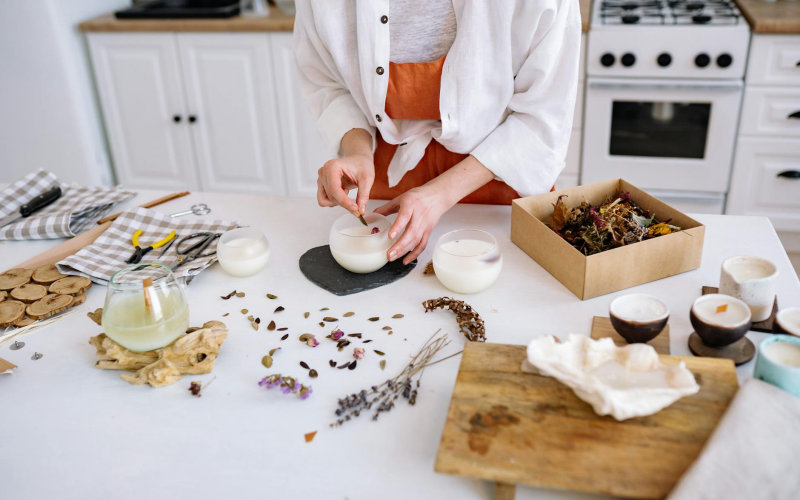

I killed my first three batches. Flowers went brown. Wax turned cloudy. One candle looked like something dredged from a bog. So if you’re sitting there nervous about trying this, good—you should know upfront that you’ll wreck a few before you get one right, and that’s not failure, that’s just the process.
What nobody bothers to tell you is that botanical candles are legitimately more technical than regular ones. The flowers aren’t some cute finishing touch you toss in at the end. They change how the wax behaves, how fast the wick burns through, and whether your finished product is a genuine fire hazard or something people beg you to sell them. I’ve spent close to four years figuring this out through actual mistakes—not just skimming other craft blogs and regurgitating tips.
When you nail it, though? A well-made botanical candle looks like something off the shelf of a Parisian boutique. Except you made it at your kitchen table, probably in your pajamas.
Gather Your Materials First (Don’t Skip This)
You need soy wax flakes—specifically a container soy wax like Golden Brands 464, which melts around 120°F and throws scent beautifully. Pillar soy blends won’t grip flower embeds the same way, so don’t swap them out. Grab cotton wicks sized for your jar (a 3-inch jar usually wants a CD-18 or ECO-10), a double boiler or dedicated wax pitcher, a thermometer, and fragrance oil if you’re going scented.
For the botanical side: properly dried flowers. And this is exactly where most beginners trip up. “Dried” doesn’t mean grabbed from the grocery store floral section. You want silica gel-dried flowers for the truest color preservation, or pressed flowers if you’re doing surface decoration only. Lavender, globe amaranth, strawflowers, statice—these are the reliable workhorses. They keep their color, they don’t shed moisture, and they won’t drain your wallet.
Your startup kit runs somewhere between $60-80 if you shop sensibly. Floral Street Studio on Etsy (one of my go-to spots for inspiration) sells pre-dried botanical mixes for around $12-15 if drying your own sounds like too much right now.
How to Dry and Prep Your Flowers Properly
Fresh flowers carry moisture. And moisture trapped in a candle means steam when it burns—which causes popping, crackling, and blooms that turn black and hideous on the first light. So yeah, drying matters way more than most tutorials admit.
Silica gel drying takes 3-7 days depending on how dense the flower is. You bury the blooms completely in silica gel crystals (any craft store sells them, roughly $8 a bag), and the crystals pull the moisture out slowly. Roses and peonies sit closer to the 7-day mark. Queen Anne’s lace or baby’s breath? Three days, usually done.
Pressing works beautifully for surface embeds—flowers pressed flat against the outside of your glass before pouring. But pressed flowers can’t go into the wax itself. Too fragile. They’ll just fall apart.
One non-negotiable: your flowers have to be bone dry. Crinkly, papery, almost brittle. If a petal still has any give when you pinch it, keep waiting.
Setting Up Your Wax Pour Station
Temperature is everything here. Pick up a cheap infrared or candy thermometer—I’ve used a $14 digital one from Amazon for three years and it’s never lied to me.
Melt your Golden Brands 464 to around 185°F, then let it drop to 140-145°F before your fragrance goes in. Add roughly 1 oz of fragrance per pound of wax for a medium throw (you can push to 1.5 oz, but test before committing). Stir slowly for two full minutes. Seriously, don’t rush it—fragrance pooling at the candle’s base is almost always caused by cutting this step short.
Pour temperature is especially critical for botanical work. You want 130-135°F. Too hot, and your wall-pressed flowers will shift or discolor. Too cold, and you’ll get air bubbles and sad adhesion. That narrow window is where the good candles happen.
Placing Your Botanical Embeds
Two main techniques. Outside embeds: you press dried flowers against the inner wall of the glass before pouring. Inside embeds: flowers go directly into the poured wax, layer by layer.
For outside embeds, brush a tiny dab of melted wax onto each flower and press it gently against the glass. Work fast—you’ve got maybe 30 seconds before it sets. I start from the bottom third of the jar and work upward: a few lavender stems, a strawflower, some statice sprigs. Take your time arranging because this is literally the face of your candle.
Inside embeds are slower. Pour your first layer about an inch deep, let it firm up but not fully harden (20-25 minutes, usually), then lay flowers on the surface and pour a thin second layer over them. Repeat until you reach the top. It tests your patience. But a layered botanical candle backlit by a flame? Genuinely one of the prettier things you can make by hand.
Wick Placement and Curing
Center your wick before anything else. A proper wick centering tool works great, but honestly—two pencils taped across the jar opening does exactly the same job. The wick needs to be taut and anchored to the jar bottom with a wick sticker or small dab of hot glue.
After your final pour, leave it alone for at least 48 hours. Soy wax needs that curing window for the fragrance to bind and the surface to settle properly. I wait 72 hours personally. Some makers hold out a full week before testing. (The longer cure really does improve scent throw—it’s not just candle-maker mythology.)
Trim your wick to 1/4 inch before the first burn. Then trim it again before every single burn after that.
Common Mistakes and How to Fix Them
Flowers blackening during burning means they’ve drifted into the burn path. Keep all botanicals in the outer third of the jar, minimum one inch of clearance from the wick center. No exceptions.
Wet spots—those patchy separations you see against the glass—are a soy wax quirk, not something you did wrong. Temperature shifts during cooling cause them. They don’t touch burn quality at all, though pouring slightly cooler and keeping the candle away from drafts while it cures helps reduce them.
Frosting, that white crystalline surface haze, is also completely normal with soy. It actually tells you you’re using the real thing. Some makers leave it; others hit it with a heat gun on low right after pouring. Both are fine.
Bottom Line
Here’s the thing I’ve genuinely never seen anyone else say out loud: the botanical candles that look expensive and intentional aren’t the ones stuffed with the most flowers. They’re the ones with deliberate negative space. Three well-placed strawflowers will always beat a chaotic pile of twelve. Your eye needs somewhere to rest inside that glass. Restraint is the actual skill—and it’s what took me the longest to learn. Less is better here, measurably and visually, and honestly that lesson bleeds into a lot of things beyond candle making.
Frequently Asked Questions
Can you use fresh flowers in soy wax candles?
No. Moisture in fresh flowers leads to mold, discoloration, and genuinely risky burning behavior. Always use fully dried flowers—silica gel dried or properly pressed—before anything touches wax.
What’s the safest dried flower for a beginner?
Strawflowers. They hold color better than almost anything else, dry quickly, and keep their structure intact through the pour. Start there before moving on to more delicate botanicals.
How long do botanical soy candles last?
A well-made 8 oz soy candle with a standard 1 oz fragrance load burns for roughly 45-55 hours. Botanical embeds don’t meaningfully cut into burn time as long as they’re placed outside the direct melt pool.
Are botanical candles safe to burn indoors?
Yes—when made correctly. Keep all botanical material away from the wick and the melt pool, with at least 1 inch of clearance from the wick center. And never leave any candle burning unattended. That rule applies to every candle, botanical or not.
Photo by Yan Krukau on Pexels