
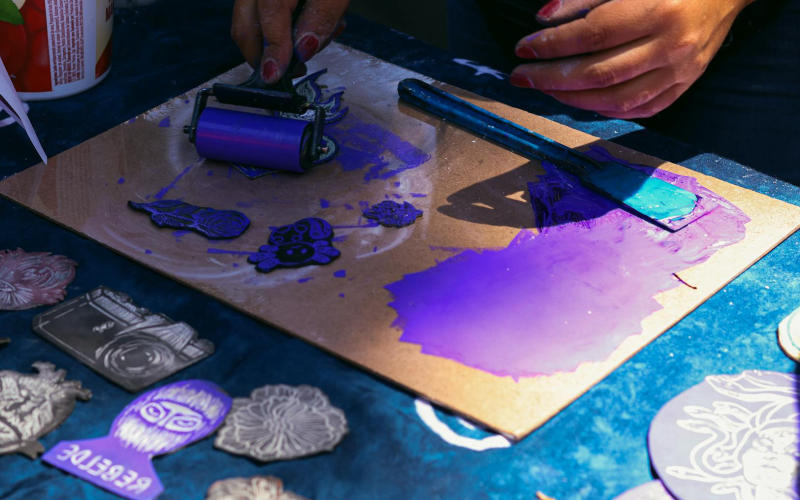

I bought my first lino cutting kit in 2019 from a tiny art supply shop in Portland, stared at it for three weeks, and then gouged a crooked leaf into a piece of grey linoleum and somehow fell completely in love with the whole messy process. It was ugly. Genuinely, embarrassingly bad. But something about carving into a physical object and pressing it onto paper—making an actual mark—felt more satisfying than anything I’d done with a paintbrush in years.
Here’s what nobody tells beginners about linocut printing: the projects you start with matter enormously. Pick something too complicated and you’ll quit. Pick something too simple and you won’t learn the techniques that make this craft worth doing for the next decade. So I’ve put together seven beginner linocut block printing projects that are strategically chosen to teach you one new skill each—not just fill an afternoon.
These aren’t just “cute ideas.” Each project builds on the last. By the time you finish all seven, you’ll understand line weight, negative space, registration, and multi-color printing without ever sitting through a formal class.
1. The Single Leaf Print (Your First Real Mark)
Start here. Not a flower, not an animal—a single leaf.
Why? Because a leaf has veins (which teach you to carve thin lines without snapping your tool), an irregular organic edge (which forgives imperfect cutting), and enough visual complexity that the finished print looks intentional even when it’s not quite.
Grab actual linoleum—not the soft pink erasers that get marketed to beginners and feel nothing like real lino. I recommend Speedball’s Soft-Kut at around $8 for a starter block. It carves cleanly without requiring serious hand strength. Trace your leaf, carve around the outline first, then carefully remove the background. Press it in black ink on cream paper. That’s it. You’ve just learned basic contour carving, and it took maybe two hours.
2. A Geometric Pattern Repeat (Learning Precision)
Once you’ve carved something organic, carve something that punishes imprecision. A simple triangle, hexagon, or diamond shape repeated in a grid will immediately expose every wobble in your lines.
This project teaches you something genuinely valuable: how to plan your carving before your tool ever touches the block. Geometric work forces you to draw with a ruler, think hard about what you’re removing versus keeping, and commit to clean cuts. No fudging it.
The real skill here is understanding positive and negative space—the white parts and the black parts—which is honestly the foundational concept behind everything in block printing. So spend time on this one. Carve slowly. And when your hexagons turn out slightly lopsided (they will, I promise), look at how the ink sits on paper and decide whether you love it anyway. Most people do.
3. A Portrait of Your Pet (Handling Curves and Contrast)
Okay, this one sounds hard. It isn’t, if you simplify ruthlessly.
Take a photo of your pet—or a friend’s pet, whatever—and reduce it to high-contrast black and white in any free photo editor, even the one already on your phone. Now you’re not drawing fur. You’re carving blocks of shadow. This is called reduction drawing, and it’s the technique that makes linocut portraits achievable for anyone with less than six months of practice.
The specific skill you’re building here: deciding what detail to include and what to sacrifice. That’s actually an advanced compositional instinct, and you’ll feel it click somewhere around your third attempt when the image suddenly reads as a cat from ten feet away. That moment is genuinely thrilling.
4. A Simple Botanical Border (Introduction to Registration)
Registration just means lining up your block consistently across multiple prints so they match each other. Sounds tedious. It’s actually the skill that separates people who make five prints from people who make five hundred.
For this project, carve a simple sprig—three leaves on a stem works perfectly—and then print it repeatedly to build a rectangular border on a card or sheet of paper. You’ll need small pencil marks on your paper to tell yourself exactly where to place the block each time. Do this by hand first, without tape guides. Feel the imprecision. Then try tape guides. Notice the difference.
The real-world payoff is concrete: you can now make greeting cards people will actually buy. At craft fairs in 2023, hand-printed linocut cards were consistently selling between $5 and $8 each. I watched a vendor in Seattle move about 60 cards in a single afternoon.
5. A Two-Color Print (The Thing That Changes Everything)
This is where people either get hooked for life or throw their tools across the room. Two-color printing means carving two separate blocks and printing one on top of the other in registration.
Start with a color combination that looks good even slightly misaligned—try a mustard yellow under a deep navy. The overlap creates a third color organically, which feels like cheating but is just physics doing its thing. Print your yellow layer first across an entire batch (say, 20 sheets), let it dry for 24 hours, then print your navy layer on top using the registration marks you practiced in project four.
You’ll learn ink mixing here too. Water-based block printing ink from brands like Schmincke or Daniel Smith gives you predictable, mixable color. But don’t buy cheap craft-store ink for this step—it bleeds, dries at the wrong rate, and will genuinely ruin your afternoon.
6. A Repeating Fabric Stamp (Carving for Texture)
Print on fabric. Specifically, print a small repeating motif—a moon, a star, a simple arrow—onto natural linen or a plain cotton tote bag.
Fabric printing teaches you about pressure and ink consistency in ways that paper simply never will, because fabric absorbs ink differently and every surface is slightly uneven. You’ll oversaturate the block once. Undersaturate it twice. But by your fifth stamp you’ll have an intuitive feel for how much ink is enough, and that instinct transfers back to paper printing permanently.
Use fabric-specific ink, or add a textile medium to your regular ink. Heat-set it with an iron afterward. And honestly? People will ask where you bought that tote bag.
7. A Full-Scene Reduction Print (Putting It All Together)
Your final project should scare you slightly. A reduction print—where you carve away more and more of a single block between each color layer—is a one-shot technique. You cannot reprint the earlier layers once you’ve cut them away.
Pick a simple landscape: a tree, a horizon line, one moon. Print it first in your lightest color across 15 sheets. Carve away everything you want to stay light. Print your middle color. Carve again. Print your darkest color. Each pass eliminates your ability to go back.
The irreversibility is the whole lesson. It forces commitment in a way nothing else does. And it produces prints that look, genuinely, like fine art—overlapping color transparency creates depth that flat digital printing can’t touch. Artists like William Kentridge have built entire careers around exactly this kind of physical irreversibility.
Bottom Line
Here’s something I haven’t seen written anywhere else: the order you do these projects in actually rewires how you see images in real life. After six months of linocut work, I started automatically simplifying everything I looked at—trees became shapes, faces became value contrasts, fabric patterns became repeating stamps. That visual simplification instinct is what separates linocut artists who make compelling work from people who just make technically correct prints. You’re not only learning a craft here. You’re installing new visual processing software in your brain, and these seven projects are the installation sequence.
Frequently Asked Questions
What tools do I actually need to start beginner linocut block printing projects?
You need a lino block (Speedball Soft-Kut is a solid $8 starter), a basic V-gouge and U-gouge cutting set (around $15-20), water-based block printing ink, a small brayer roller, and paper. That’s it. Don’t buy a fancy kit until you know you love it.
Is linoleum the same as the erasers sold for block printing?
No, and it matters. Soft pink erasers marketed as “block printing tools” are much softer than real linoleum and don’t carve cleanly at a detailed level. Real linoleum gives you more resistance, which actually gives you more control over your lines.
How long does a typical beginner project take?
A simple leaf or geometric block takes 1-2 hours to carve and another 30 minutes to print a small edition. More complex projects like a two-color print or reduction print can take 4-8 hours spread over two days once you factor in drying time.
Can I do linocut printing without a printing press?
Absolutely. Most beginners—and plenty of experienced artists—use hand pressure or the back of a wooden spoon to transfer ink to paper. A printing press gives you more consistency across large editions, but you can make beautiful work entirely by hand for years before ever needing one.
Photo by sury Onaly on Pexels