
You spend three hours on a resin piece. You demold it the next morning, hold it up to the light, and it’s perfect. Two weeks later it looks like someone soaked it in tea. Sound familiar?
This is the most common frustration in resin crafting, and the advice floating around online barely scratches the surface. Most tutorials blame “UV exposure” and call it a day. But yellowing often starts before your piece ever sees sunlight — during the cure itself. That’s the part nobody talks about.
The Actual Chemistry Behind Why Resin Turns Yellow
Here’s what’s really happening. UV light breaks down the aromatic amine bonds in your hardener component, producing carbonyl groups (those C=O structures chemists write about). Those carbonyls are chromophores — the actual molecular structures that create color. According to INCURE INC.’s December 2025 technical breakdown, this is a permanent structural change at the polymer chain level, not a surface stain you can buff out.
The uncomfortable truth: your hardener is the primary variable in long-term yellowing resistance. Not the resin brand name on the front of the box. Not the color of the bottle. The quality of the amine chemistry in the hardener. Budget kits skip the stabilizers that protect those bonds because stabilizers cost money. The label still says “crystal clear.”
And yes, this means many cheaper imported kits flooding the market right now are designed to photograph beautifully in a 60-second unboxing video and fail within months. With resin art generating profit margins up to 70% — driving a DIY boom that pushed the U.S. art and craft materials market to USD 6.52 billion in 2026 — there’s serious financial incentive to sell kits that look good at launch.
The Temperature Window That Most Kits Never Mention
Epoxy cures best between 70°F and 80°F, below 60% humidity. That’s a pretty narrow window. Go below 55°F and your cure turns chalky white, requiring sanding and full recoating. Push above 80°F and you trigger a runaway exothermic reaction. the resin generates its own heat, and that internal heat causes yellowing, distortion, and sometimes cracking.
So here’s the scenario nobody puts in the beginner tutorial: you pour a thick batch in summer, your craft room is 85°F, and you think the warmth will help it cure faster. It does cure faster. It also yellows during the cure, before it ever sees a window. That’s exothermic yellowing, and UV-resistant resin cannot save you from it because UV had nothing to do with it.
Measure your room temperature before you pour. Every time. This one habit alone prevents a huge percentage of yellowing failures.
Using Coating Resin in Deep Molds Is a Setup for Failure
This is the resin type mix-up that catches so many beginners. Coating resins are formulated to be crystal clear in thin layers, typically under 1/8 inch. Pour them into a deep mold and they don’t just cure slowly; they turn visibly amber. Mill Lane Studio has photographic documentation of exactly this failure pattern, and it’s striking how reliably it reproduces.
Only casting or deep-pour epoxies are chemically formulated to handle thick pours without generating the kind of exothermic heat that causes color shift. Check the product spec sheet, not just the product name. “Art resin” doesn’t tell you anything about pour depth limits.
The Titanium White Problem Nobody Warns You About
If you’ve ever painted a white base layer, let it dry for a day, poured resin over it, and watched the whole thing cloud up or yellow. titanium white is probably why. Titanium dioxide (TiO₂), the pigment in titanium white paint, chemically interacts with epoxy resin regardless of brand. It accelerates yellowing. According to ArtResin’s technical documentation and a July 2025 post from BondCraftor, this reaction happens across all epoxy formulations without exception.
But wait, it gets worse. Oil-based paints containing TiO₂ can take weeks or even years to fully cure. Pouring resin over paint that hasn’t finished off-gassing is a direct path to clouding and yellowing. If you’re using titanium white, switch to acrylic-based alternatives, let them cure fully, and seal before you pour.
How to Read a Resin Label Without Getting Fooled
Two terms matter for yellowing resistance: UV absorbers and HALS (Hindered Amine Light Stabilizers). These are not the same thing. UV absorbers work like sunscreen. they convert UV radiation to heat. HALS neutralize free radicals and, critically, regenerate over time, which is why they provide longer-lasting protection.
Most budget resins skip both. Some include one. Premium options like ArtResin (which is ACMI AP Non-Toxic Certified and engineered with both a UV Light Stabilizer and HALS) and LET’S RESIN’s Crystal Clear Plus UV Resistant Epoxy Resin (which markets 3× stronger anti-yellowing versus standard epoxy) include both stabilizer types. Clearcast 7050 from The Epoxy Resin Store also combines UV absorbers with HALS in a 2:1 mix ratio.
Here’s what “low VOC” or “non-toxic” tells you: nothing about yellowing resistance. Zero. Those are regulatory classifications, not performance indicators. Don’t conflate them.
One more thing: more UV inhibitor additive is not always better. Superclear Epoxy Resin Systems, which updated their Super-UV Inhibitor guidance in May 2026, specifically caps their HALS additive at no more than 1% of total epoxy volume, about 1.2 oz per gallon, added to the hardener side first. Overdoing it causes haziness and curing problems. There’s a ceiling.
The Sealant Trap Most Guides Miss Completely
Here’s something I’ve almost never seen covered in mainstream craft content. You do everything right. correct temperature, right resin type, quality HALS formulation, and your piece still yellows. Often the culprit is the finishing spray you applied on top.
Many standard spray sealants are not UV-stable. They yellow on their own. And when they do, your whole piece looks yellow even though the resin underneath is fine. TotalBoat recommends using their Halcyon Clear Gloss Varnish specifically as a UV-stable topcoat over cured epoxy, and it’s one of the few sealant options with actual UV resistance built in. If your sealant isn’t rated for UV stability, skip it or replace it.
Also worth knowing: EU REACH and BPA regulations tightened significantly in 2025, forcing reformulations of several popular imported epoxy brands. If you’ve been using a kit that worked great in 2023 and are now seeing different results, the formula may have changed. Old reviews are not reliable for current batches.
What I’d Actually Do If I Were Starting Over
Stop blaming sunlight first. Start with temperature control, resin type matching, and hardener quality. in that order. Those three variables cause the majority of yellowing failures, and they’re all fixable before you pour.
If you want to upgrade your setup without replacing everything at once: add a HALS-based aftermarket additive like Superclear’s Super-UV Inhibitor to your current resin, stay in the 70–80°F window, and swap your finishing spray for a UV-rated varnish. That combination eliminates most of the controllable failure points. The yellowing that remains after that? That’s chemistry doing its thing over years, not weeks.
Frequently Asked Questions
Can I fix resin that’s already turned yellow?
No. Yellowing is a permanent structural change at the molecular level, it’s not surface discoloration. Your only option is to physically sand down the yellowed layer and recoat with fresh resin. Most online guides understate how final this is.
Is UV resin safer from yellowing than two-part epoxy?
Often the opposite. Many single-part UV resins yellow faster than high-quality two-part epoxies that contain HALS additives. “UV resin” refers to how it cures, not how it resists UV over time.
My hardener looked yellow in the bottle.
Should I toss it?
Probably not. A yellowed hardener typically still cures correctly. it just won’t produce as optically clear a result as fresh resin. If clarity is critical to your project, use a fresh batch. But don’t assume yellowed hardener is unusable.
Does indoor lighting cause yellowing too?
Yes. Fluorescent and some LED lighting emit low levels of UV. Combined with oxidation and heat from torching, indoor conditions alone can cause gradual yellowing, especially in cheaper, unstabilized resins. Sunlight just speeds up a process that’s already happening.
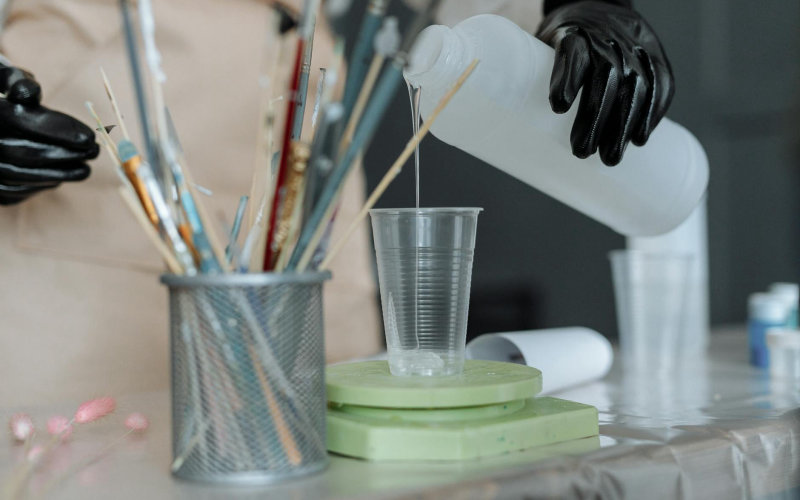
Photo by Thirdman on Pexels