

I bought both on the same Amazon order back in 2019. Dropped probably $60 total, spread everything across my kitchen table, and promptly made a disaster with each of them. One disaster looked gorgeous. The other was just… a disaster.
That afternoon taught me more than a dozen YouTube tutorials ever could. If you’re standing in a craft aisle — or hovering over your Michaels cart at midnight — trying to pick a starting point, I’ve been exactly that person. And after years of messing around with both, I’ve got real opinions.
Here’s what nobody upfront actually tells you: these two mediums aren’t just visually different. They differ in feel, in forgiveness, in how much money they’ll quietly drain from you each month, and honestly — in how much patience they expect from whoever’s holding the brush. Or the dropper. Or the straw.
What You’re Actually Working With
Watercolor is pigment suspended in a gum arabic binder. Add water, it flows. Straightforward chemistry, but controlling the results? Anything but.
Alcohol ink is dye-based pigment suspended in isopropyl alcohol. When you use it for fluid art — dropping it on Yupo paper or ceramic tiles and blowing it around — the alcohol evaporates fast. Like, startlingly fast. And that speed reshapes everything about how you work.
So you’re not just choosing a color medium here. You’re choosing a pace, a toolkit, and a cleanup routine that’ll either slot neatly into your life or make you want to throw something across the room.
Cost to Get Started
This is where most comparison posts fail you through omission. They’ll call both mediums “affordable,” which is technically accurate and practically worthless.
A beginner watercolor fluid art setup genuinely costs less. A 24-pan Arteza set runs $16-18, you’ll want some watercolor paper (Strathmore 140lb cold press, around $12 for a pad), and a few cheap brushes or a spray bottle. You’re through the door for roughly $30-35.
Alcohol inks cost more per bottle, but here’s the part that catches people sideways — you need Yupo paper or ceramic tiles as your surface, because alcohol ink beads up and destroys regular paper. A pack of 25 Yupo sheets alone runs $18-25. Throw in Ranger Tim Holtz inks (about $4-6 per small bottle) and isopropyl alcohol for diluting, and you’re already near $50-60 before you’ve produced a single piece.
Neither medium will wreck your finances. But if the budget’s tight right now, watercolor wins this round cleanly.
The Learning Curve (Honestly)
People say watercolor is hard. They’re not wrong — but the specific reason it’s hard matters. You cannot easily fix mistakes. Lay down too much pigment in the wrong spot and you’re suddenly committed to an entirely different painting. That kills the enthusiasm of a lot of beginners who are used to mediums where you can simply paint over errors.
Alcohol ink is forgiving in this strange, backwards way. Because chaos and organic movement are the whole point, there’s no such thing as a wrong pour. Your happy accidents look deliberate. I’ve literally dripped ink on a tile by accident and had someone ask if I planned it.
But — and this really is a significant but — alcohol ink gives you far less control overall. If you want to paint something recognizable, a landscape, a readable shape, anything specific, you’ll fight the medium the entire time. Watercolor, despite the steeper early curve, actually gets you to representational work faster once you’ve put the hours in.
What the Results Actually Look Like
Fluid watercolor art has this soft, almost atmospheric quality to it. Blooms, backruns, those delicate cauliflower edges that form when wet paint hits wet paint — that’s watercolor doing its thing. Think Ana Victoria Calderón, who built a massive following around loose, living watercolor botanicals.
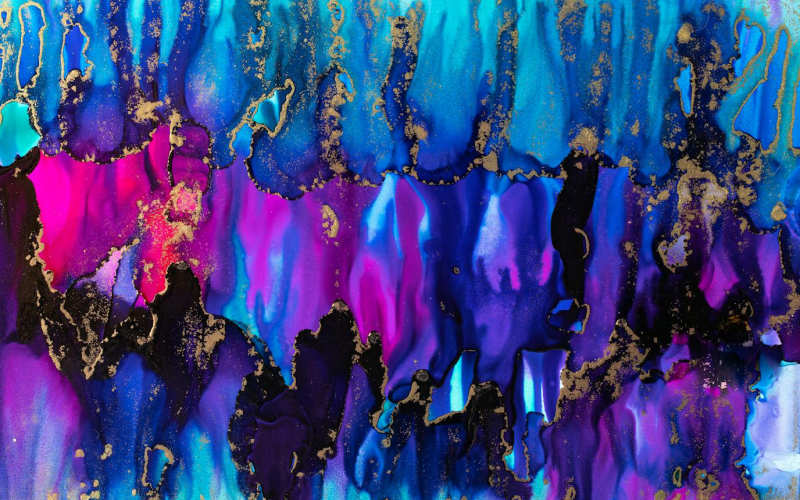
Alcohol ink fluid art is bolder. More graphic. The colors hit you — that Ranger Tim Holtz Heirloom or Botanical collection, where the purples and teals look almost neon-lit, almost electric. And the results photograph beautifully, which matters if you’re making things for Etsy or Instagram.
Which looks “better” comes down entirely to your aesthetic. No objective winner here.
Tools and Setup Requirements
Watercolor needs paper, paints, water, and something to push the paint around. Full stop. You can work at a dining table with a cup of tap water and a crumpled paper towel. Minimal setup, minimal aftermath.
Alcohol ink needs considerably more. You need real ventilation — not just a cracked window, because isopropyl fumes are legitimately strong. You need gloves, because the dye stains skin aggressively. You need a heat gun or a straw for manipulation. And your workspace needs solid protection, because alcohol ink will stain every surface it touches without hesitation.
I learned the gloves thing the hard way. My fingernails stayed purple for four days after my first alcohol ink session in 2020. Learn from my mistake.
Longevity and Archival Quality
Here’s something most beginner guides quietly skip. Archival quality — meaning how long your work survives without fading — matters the moment you consider selling pieces or hanging them somewhere permanent.
Watercolor, particularly professional-grade pigment-based paints like Daniel Smith or Winsor & Newton, can last 100+ years when stored properly. It’s the same medium used in Renaissance manuscripts. That’s not nothing.
Alcohol ink is dye-based, so it fades faster under UV exposure. Without a UV-protective varnish, some pieces show noticeable fading within 2-3 years. Not a dealbreaker, but definitely worth knowing before you frame something and hand it to someone as a gift.
Which One Is Actually Better for Beginners
Okay. Real answer. If you want immediate gratification and you’re comfortable spending $50 upfront, start with alcohol ink. The chaos genuinely works in your favor, the results look impressive almost immediately, and the whole process feels surprisingly effortless — even fun in a way you don’t expect.
If you want to build a foundational skill that bleeds into other mediums, go watercolor. It’s slower and more humbling early on, but every hour you spend understanding water-to-pigment ratios, wet-on-wet versus wet-on-dry techniques, and paper behavior makes you a sharper artist across the board.
Most people start with alcohol ink and eventually circle back to watercolor. Honestly? Not a bad path at all.
Bottom Line
Here’s the thing I haven’t seen anyone else say plainly: the medium you start with shapes how you define “success” in art. Alcohol ink trains your brain to celebrate unpredictability and release the need for control — which is actually a profound creative skill that art schools charge thousands to teach. Watercolor builds precision and patience. So choose based on which mental muscle you actually need right now, not just whichever one photographs better on Pinterest.
Frequently Asked Questions
Can you mix alcohol ink and watercolor together?
Not really. They don’t play well chemically — one’s water-based, the other’s alcohol-based. You can layer them separately on the right surface, but expect genuinely unpredictable results.
Do beginners need expensive paints to start?
Not for alcohol ink — Ranger Tim Holtz inks are mid-range and genuinely solid for beginners. For watercolor, skip the bargain-bin sets and put your money into at least student-grade, like Cotman by Winsor & Newton, which runs about $20-25 for a starter set.
Is alcohol ink safe for kids?
No. The isopropyl fumes and the skin-staining dyes make it a poor fit for younger kids. Watercolor fluid art is the far more family-friendly option.
How long does it take to learn fluid art with either medium?
With alcohol ink, you can make something you’re genuinely proud of in your very first session. Watercolor fluid art usually takes 4-6 practice rounds before things start clicking — but when they do, they really do.
Photo by Sharon Snider on Pexels