
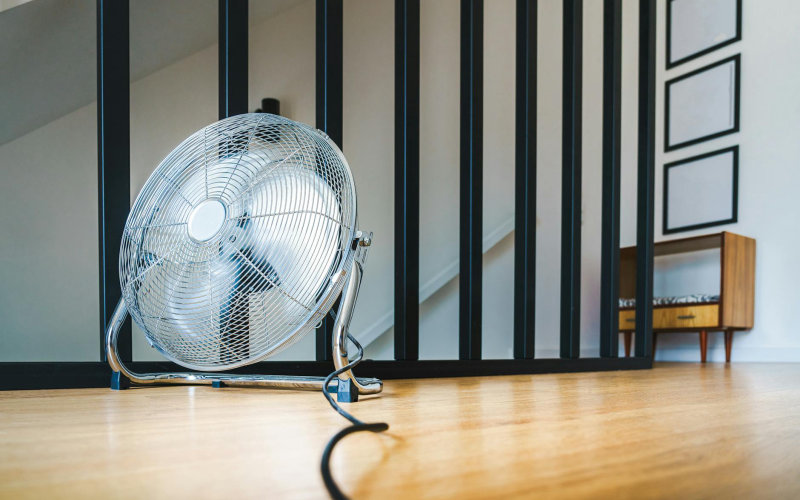

Your fan is running. You’re still sweating. What gives?
I’ve been there more times than I’d like to admit — stuck in a stuffy bedroom at 11pm, fan cranked to high, feeling like I’d crawled inside a bread machine. Here’s the thing: most people aren’t using fans wrong because they’re careless. They just never got told the right way. And fixing a couple of small things makes a difference that’s honestly kind of shocking.
So before you drop $400 on a portable AC or spend another night staring enviously at your neighbor’s window unit, try these three tricks. They’re not gimmicks. There’s real physics behind each one, and I’ll walk you through it as we go.
Why Your Fan Isn’t Actually Cooling You (And Why That’s Not Completely Its Fault)
Here’s something most people genuinely don’t know: fans don’t lower air temperature. Not even a little. What they do is speed up sweat evaporation off your skin — that’s where the “cooler” sensation comes from. Wind-chill, basically. Your body is doing all the actual cooling work. The fan just helps it along.
So if you’re running a fan in a hot, stuffy room and waiting for the thermometer to drop, you’re going to be disappointed every single time. That’s not the goal. The goal is moving the right air, from the right spot, in the right direction — past your body.
That’s the whole game. Everything below is just applying that one principle.
Trick #1: Flip Your Ceiling Fan to Counterclockwise
Most ceiling fans have a small switch on the motor housing — a tiny slider, sometimes a button. It toggles the blade direction between clockwise and counterclockwise. And here’s what tends to blow people’s minds: that direction matters enormously.
Counterclockwise (when you’re looking up at it) pushes air straight down toward you. That downward column of moving air hits your skin and triggers the wind-chill effect we just talked about. Clockwise does the opposite — it pulls air upward, which is actually useful in winter for redistributing warm air pooled near the ceiling. But in summer? Completely useless for making you feel cooler.
T.J. Laury, who runs an HVAC company called Ben’s ProServ out of Vineland, New Jersey, makes this exact point when he’s talking to homeowners. Counterclockwise equals summer. Clockwise equals winter. That’s the cheat code.
And honestly? I’d guess at least half the ceiling fans in America are spinning the wrong way right now. Check yours. Flip that switch. You might feel the difference within thirty seconds.
Trick #2: Put Your Floor Fan Low and Angle It Up at 45 Degrees
Heat rises. You already knew that. But here’s what you maybe haven’t thought through: the coolest air in any room is hugging the floor.
So when you set your tower fan on top of a dresser, you’re pulling from the warmest layer of the room. Put it on the floor instead. Then tilt the head up at roughly a 45-degree angle so it’s pushing that cooler floor-level air up and across the room — ideally, across you.
Danny Pen, president of New Era Plumbing & HVAC up in Dracut, Massachusetts, takes this a step further. He points out that placement matters as much as position — you want your fan near the coldest spot available. That might be a shaded north-facing wall, an open window on the shady side of the house, or right in front of a partially working AC vent.
So the full setup: floor placement, near a cool source, head angled up at 45 degrees. A pedestal fan with an adjustable head is ideal here because you can actually dial in that angle instead of guessing. Box fans are trickier — you’d have to prop one, which works in a pinch but isn’t exactly elegant.
Trick #3: The Ice Trick (It Actually Works, With Caveats)
You’ve seen this floating around the internet. Bowl of ice, fan blowing over it. Here’s why it isn’t complete nonsense.
As air passes over ice, it picks up cold moisture from the melting surface. What comes out the other side is genuinely cooler and slightly humid — almost like a budget evaporative cooler. It won’t drop your room temperature by 15 degrees. But in a small, closed space? You’ll feel it.
Laury calls it a “DIY evaporative cooler,” which is honestly a pretty accurate description. The physics are legitimate. But the limitations are real too — this works best in rooms under roughly 150 square feet, and it’s a short-term fix because the ice melts in 20 to 40 minutes depending on how hot things already are.
Between a bowl of ice and a frozen water bottle, go with the bowl. More surface area, faster melt, more cold air moving through. And if you want to stretch it out a bit, nest the bowl inside a larger bowl packed with regular ice around the outside. That’s something I stumbled onto during a heat wave in 2021 when our central AC died on a Friday and the repair guy couldn’t come until Monday. Was it perfect? No. Did it make sleeping in that room tolerable? Actually, yes.
Combining All Three: The Full Setup
Run them together and you’ve built a genuinely effective cooling system for essentially zero dollars (assuming you already own a fan). Ceiling fan counterclockwise, floor fan angled up from the coolest corner, bowl of ice in front of the floor fan.
Do this in a smaller room — close the door, pull the curtains on any sun-facing windows — and you might be surprised how livable things get even on a 95-degree day.
One Bonus Thing Nobody Talks About: The Box Fan Window Exhaust Method
Set a box fan in a window facing outward (blowing air out of the room) at night, once outside temps drop below indoor temps. This pulls cooler outdoor air in through other windows and vents. Cross-ventilation. It can drop your room temperature by 5 to 10 degrees overnight using nothing but the fan itself.
Open a window on the opposite side of the room. Fan blows out one side, cool air gets drawn in the other. Simple. Old. Works.
Bottom Line
Here’s what nobody really says out loud: your comfort in a hot room has almost nothing to do with how expensive your fan is. It has everything to do with air movement strategy. A $35 box fan positioned correctly — pulling cool floor air at 45 degrees near a shaded wall — will outperform a $200 tower fan sitting on a shelf and pushing stale hot air across a room. Every single time.
The real insight is this: you’re not trying to cool a room, you’re trying to cool your body. And those are two completely different problems. Stop trying to fix the whole room. Aim the cold air at yourself. Small spaces, closed doors, multiple fan layers, ice when you need it. That’s the whole system.
Frequently Asked Questions
Does putting a wet towel on a fan actually help?
Sort of. A damp towel draped over the front of a box fan creates a mild evaporative cooling effect — similar to the ice trick. Air passing through picks up moisture and comes out slightly cooler. But this works best in low-humidity environments. If you’re in Florida in August, don’t bother — the air’s already saturated and you won’t notice a thing. In a dry climate like Arizona or Colorado, though? Surprisingly effective.
How many degrees can a fan realistically drop a room temperature?
Fans don’t lower air temperature at all — that’s the important thing to hold onto. What they change is how cool you feel, which can be equivalent to a 4 to 8 degree difference in perceived temperature, thanks to wind-chill on your skin. The ice trick can nudge actual temperature down slightly in a very small enclosed space, but we’re talking maybe 2 to 4 degrees — not 15.
What’s the best fan direction for sleeping?
Ceiling fan counterclockwise, on low speed. You don’t want a direct blast of air on you all night — that dries out your sinuses and messes with sleep quality. A gentle counterclockwise rotation creates a soft downward airflow that keeps you cool without turning your bedroom into a wind tunnel.
Can I use this ice fan trick for a whole house?
No. And I want to be straight with you: this is a temporary fix for small spaces. A bowl of ice in front of a fan can make a 100 to 150 square foot bedroom feel more bearable. In an open-plan living space? You’d barely notice it. For larger areas, your best bet is the window exhaust method at night combined with blocking direct sunlight during the day — those two things together will do more than any ice trick ever could.
Photo by Jakub Zerdzicki on Pexels