

I’ve watched friends panic and drop $800 on a pest inspection that came back completely clean—because they’d mistaken wood rot for termite activity. And I’ve seen the opposite go just as badly: someone shrugging off obvious termite galleries as “just some old rot” until the repair bill landed at $14,000. Both mistakes hurt. Both are avoidable with about 20 minutes of your own legwork.
This isn’t written for pest control companies. It’s for you—the homeowner standing in your crawl space with a flashlight, poking at something that looks wrong, wondering what the heck you’re actually dealing with.
So let me walk you through what separates these two problems. They genuinely do look similar early on, and the fix for one has almost nothing to do with the fix for the other.
The Fundamental Difference Most People Miss
Termites are alive. Wood rot is chemistry.
That sounds almost too simple, but it matters enormously for how each problem spreads and what it looks like up close. Termite damage comes from subterranean or drywood colonies physically eating your wood from the inside out—leaving the outer shell largely intact until things get severe. Wood rot is a fungal process. Specifically, fungi from the Basidiomycota family break down either the cellulose or the lignin in your wood, depending on which type of rot you’re dealing with.
That distinction explains something people find confusing: termite-damaged wood often looks cosmetically fine right up until you press on it and your finger punches straight through. Rot, on the other hand, usually shows visible discoloration and surface texture changes much earlier.
What Termite Damage Actually Looks Like
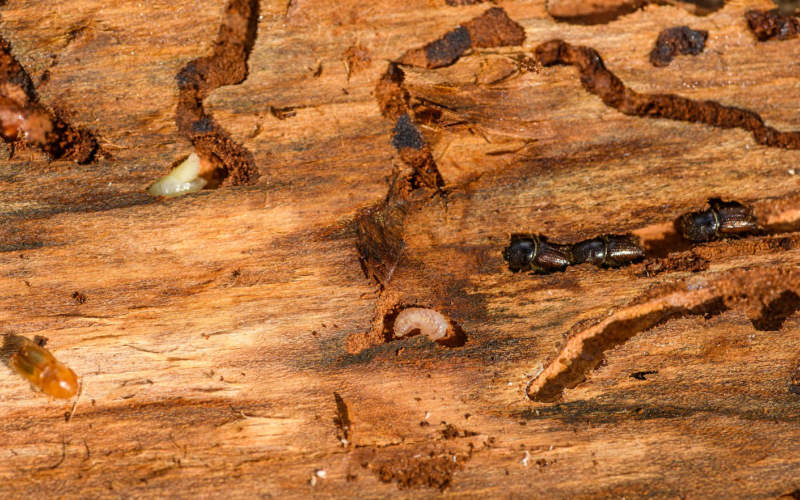
Subterranean termites—the most destructive species in North America—eat along the grain, targeting the soft spring wood and leaving the harder summer wood behind. Cut into affected wood and you’ll see something that looks like a honeycomb or a layered, hollowed-out pattern. It tends to look surprisingly clean inside. No smell. No visible mold. Just empty tunnels where solid wood used to be.
You’ll also want to look for mud tubes. These pencil-thin tunnels—built from soil, saliva, and wood particles—are basically the calling card of subterranean termites. Find one running up your foundation wall and you’ve almost certainly got an active or previous colony working somewhere nearby. They’re roughly 1/4 to 1/2 inch wide, and they’re not subtle once you know what you’re looking for.
Drywood termites leave different evidence entirely. Small piles of pellets—almost identical to coffee grounds or fine sawdust—near tiny exit holes in the wood. That’s called frass. A little pile of grainy debris sitting below a pinhole in your baseboard? That’s a serious red flag, not something to brush off.
What Wood Rot Actually Looks Like
There are two main types, and they behave completely differently from each other. Brown rot (sometimes called “dry rot”) makes wood shrink, darken, and crack into these distinctive little cube-shaped pieces. People describe it as looking like charred wood, or a chocolate brownie just crumbling apart in your hands. White rot attacks the lignin instead, leaving wood pale, spongy, and almost stringy in texture.
Both need moisture to survive. That’s the single biggest diagnostic clue you have. Find rot anywhere in your home, and you’ve also found a moisture problem. Fix the moisture source—or the rot comes back, no matter how many times you replace the wood.
Smell matters too. Active rot gives off a musty, earthy odor, sometimes almost sweet depending on the fungal species involved. Termite damage by itself? Almost no smell at all.
The Overlap Zone (This Is Where People Get Confused)
Here’s the part that trips most people up: termites actively seek out wood that’s already been softened by moisture or early rot. In practice, you often find both problems in the same piece of wood—especially in crawl spaces, around bathroom plumbing, or near exterior door frames.
A 2019 study out of the University of Florida’s entomology department found that subterranean termite activity was significantly higher in structures that already had fungal decay present. The two problems feed each other, sometimes literally.
So if you’re poking at a floor joist near a slow bathroom leak and something crumbles under your finger, don’t just chalk it up to rot and move on. Look harder. Check for the grain pattern inside. Look for mud tubes. Look for frass. You might be dealing with both at once.
The Screwdriver Test (The Most Practical Field Method)
Grab a flathead screwdriver. Apply firm pressure. Poke the suspect wood perpendicular to the grain.
Healthy wood resists and maybe splinters a bit. Termite-damaged wood resists on the surface but then collapses suddenly underneath—there’s a specific feeling to it, like it gives way all at once in a hollow, unsupported way. Rot-damaged wood usually fails more evenly: sometimes spongy, sometimes crumbly, depending on which type you’ve got.
Run the screwdriver along the surface as well. Termite galleries follow the grain, so you can sometimes trace the tunnel pattern even from the outside. Rot damage tends to spread more randomly, radiating outward from whatever moisture source is feeding it.
I’ve used this method on four different properties over the years. It’s not 100% definitive—nothing short of opening the wood really is—but it gives you enough information to decide whether you need a pest inspector, a contractor, or (most commonly) both.
When You Actually Need to Call Someone
Call a licensed pest inspector first if you find mud tubes, frass, or that characteristic hollow gallery pattern inside the wood. Most reputable companies offer free inspections—Terminix, Orkin, and plenty of local operators all do this. But don’t sign anything the same day. Take the inspection report home, read it that night, and think it over.
Call a contractor—specifically one with structural repair experience—if you’ve found rot that’s compromised a load-bearing member. Sagging floors, soft spots near exterior walls, any joist or beam that deflects noticeably under your weight—those aren’t wait-and-see situations.
And honestly, if you’re genuinely unsure about the scope of things, spending $150–200 on a certified home inspector (look for ASHI or InterNACHI credentials) before you spend anything else is usually money well spent. They’ll at least give you a clearer picture of what you’re actually dealing with.
Bottom Line
Here’s something I haven’t seen written anywhere else, and it might be the most useful thing in this whole guide: the location of the damage tells you almost as much as the damage itself.
Termite damage almost always starts from the ground up, or from wood-to-soil contact points—regardless of species. Rot almost always starts from a moisture source and spreads outward, concentrating around plumbing, roof leaks, or grade-level water intrusion. If the damage is near a roofline with no mud tubes and the wood is dark and cracking into little cubes, that’s rot. But if you’re finding damage in floor joists running parallel to your exterior foundation wall with zero visible moisture source? Trust that instinct—it’s suspicious enough to warrant a pest call.
Map the damage location before you call anyone. It’ll save you money and make you a much sharper conversation partner with whoever shows up at your door.
Frequently Asked Questions
Can termite damage and wood rot look identical?
In early stages, genuinely yes—they can be very hard to tell apart without cutting into the wood. But the grain pattern inside, the presence or absence of mud tubes or frass, and the smell (rot is musty, termite damage has almost none) will usually get you to the right answer.
Does wood rot attract termites?
It does. Moisture-softened wood is easier for termites to consume, so rot and termite activity frequently show up together—especially in crawl spaces and around plumbing penetrations.
How fast does termite damage progress?
A mature subterranean colony—anywhere from 60,000 to 1 million workers—can chew through roughly one linear foot of a 2×4 pine board in about five months. Not overnight, but faster than most homeowners expect.
Is it safe to stay in a house with termite damage or wood rot?
Depends entirely on what’s been compromised. Surface damage to non-structural wood? Probably fine in the short term. Damage to load-bearing joists, beams, or posts? Get a structural assessment before you make that call yourself.
Photo by Petr Ganaj on Pexels