
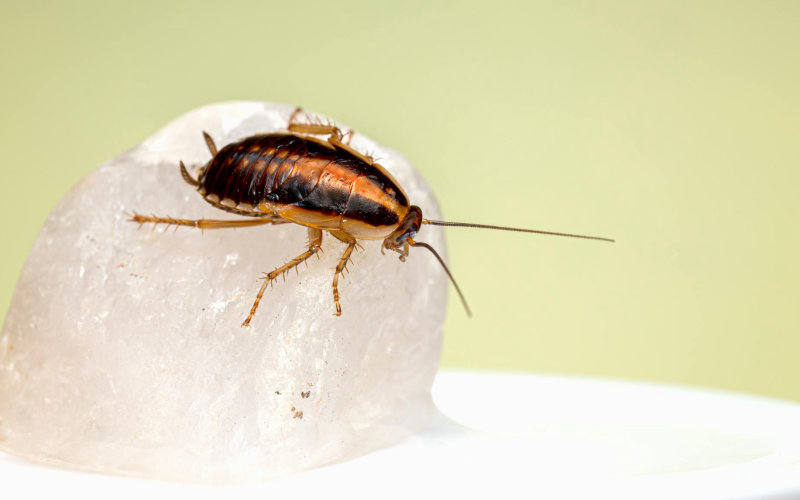

You buy the Combat or Raid gel, slap it under the sink, maybe squeeze some behind the fridge. First week? Dead roaches everywhere. You’re feeling like a genius. Then week three hits and the survivors are literally walking over the bait like it’s furniture.
That’s not your imagination. And it’s not a bad batch of product. What you’re watching is one of the more fascinating — and genuinely frustrating — examples of rapid insect adaptation playing out in real time inside your kitchen cabinets.
I’ve been writing about pest control for over a decade, and the question I get more than almost anything else is some version of “why does roach bait stop working.” The short answer is complicated. The full answer is going to change how you think about roach control entirely.
Roaches Are Evolving Against Your Bait. Literally.
This isn’t a figure of speech. Back in 1993, researchers first documented glucose aversion in German cockroaches — a genetic mutation causing them to perceive glucose (a key sweetener in most roach baits) as bitter rather than attractive. Then a 2013 North Carolina State University study published in Science confirmed this trait had spread massively through urban cockroach populations across the United States.
Think about what that actually means. The roaches that survived your first round of bait were disproportionately the ones carrying that glucose-aversion gene. They reproduced. Their offspring have it too. You didn’t kill your roach problem — you selected for roaches that hate your bait.
So when people tell me the same product that worked in 2019 seems completely useless in the same apartment now? They’re not wrong. Different roach population. Different genetics.
The “Bait Shyness” Problem Nobody Talks About
Beyond genetic resistance, there’s a behavioral issue called bait aversion — and it’s distinct from the glucose thing. Even roaches without genetic glucose aversion can learn, through population-level exposure, to avoid a food source that previously made members of their colony sick.
German cockroaches, which account for roughly 90% of indoor infestations, have a 30 to 40-day reproductive cycle. That’s fast enough that a single resistance trait can dominate a local population within months of consistent bait pressure.
Pest pros know this. So they never rely on a single active ingredient for more than one treatment cycle. In my experience watching professional applications, rotation is non-negotiable — you switch active ingredients every 30 to 45 days minimum. Not brands. Not packaging. Actual chemical actives.
What You’re Missing on the Label
Here’s something most people never check: the active ingredient listed on the back of the box. You might switch from Combat to Advion thinking you’ve finally changed things up. But if both contain indoxacarb, you’ve changed absolutely nothing from the roach’s perspective.
The major active ingredients in roach bait right now are indoxacarb (Advion), fipronil (Combat Max), imidacloprid, dinotefuran, and abamectin. Professionals rotate between chemical classes — not just products. That’s the critical distinction.
So your actual job when you grab something off the shelf is reading that tiny active ingredient disclosure and comparing it to whatever you used last time. Sounds tedious. It is. But it’s the entire ballgame.
Placement Is Probably Wrong Too
Even with the right chemistry, bad placement destroys effectiveness. Roaches are thigmotactic — they crave tight contact with surfaces on multiple sides simultaneously. They don’t hang out in open spaces. They run along walls, live inside cabinet hinges, squeeze into the gap between your refrigerator compressor housing and the floor.
Most people apply bait in big smears. Wrong approach. Professionals apply small pea-sized dots — around 10 to 15 individual placements per room — directly in cracks, hinges, under drawer slides, and against wall-floor junctions. The bait matrix needs to stay moist and attractive, not dry out sitting exposed in some open corner.
And here’s the thing nobody says clearly enough: don’t clean around the bait. Bleach and citrus cleaners repel roaches and contaminate the bait matrix. I’ve personally watched people apply professional-grade gel and then wipe down the cabinet with Pine-Sol two days later, then wonder why nothing’s working.
The Contamination Factor That Destroys Your Bait
Competing food sources are the silent killer of every roach bait program. If you’ve got a half-open bag of dog food in the pantry, crumbs under the stove, and a leaky pipe under the sink — your bait is basically irrelevant. You’ve handed roaches a full buffet and asked them to choose your little poisoned dot instead.
Professionals do a sanitation assessment before they ever crack open a tube of gel. They’re looking for moisture sources (roaches need water more urgently than food, actually), food debris, and harborage zones. No sanitation improvement means no effective bait program. Full stop.
The 2019 field guidelines from the National Pest Management Association specifically list sanitation as the first pillar of roach management — not chemistry, not traps, not foggers. First. Sanitation.
Why Foggers and Sprays Are Making Things Worse
I know this sounds backward, but if you’re using roach bombs or spray pesticides alongside your bait — you’re actively sabotaging yourself. Aerosol and residual sprays are repellent by nature. They scatter roaches into walls and voids and, crucially, they contaminate bait placements with repellent chemistry.
Roaches exposed to pyrethroid sprays (the most common OTC sprays) don’t die cleanly. They scatter. They spread to new areas of your home. And then they avoid anything that smells like that spray — including your nearby gel bait.
Pest pros working in roach-heavy accounts almost never fog. They use bait, targeted crack-and-crevice application of non-repellent actives, and sometimes insect growth regulators like hydroprene to sterilize the population rather than just knock adults down.
Bottom Line
Here’s something I haven’t seen written plainly anywhere: the reason roach bait stops working isn’t really about the bait at all — it’s about your treatment model. OTC products are designed to be purchased repeatedly, not to permanently solve your problem. The entire retail pest control category depends on you buying another box next month.
Professionals solve infestations because they treat the roach population as a dynamic, adapting system — not a static target you spray once and forget. They’re thinking about resistance, rotation, sanitation, and harborage all at once. They’re also monitoring with sticky traps between visits to know whether populations are dropping or just shifting location.
My honest advice? If you’ve been fighting roaches for more than 60 days with OTC products, stop buying more of the same. Either consult a professional or commit to a proper rotation protocol using products with genuinely different active ingredients, combined with a real sanitation effort. Anything less is just feeding the problem.
Frequently Asked Questions
How long does it take for roach bait to stop working?
Resistance can develop within a single roach generation — as few as 30 to 40 days in German cockroaches. Most people notice bait effectiveness declining around the 3 to 4 week mark, which lines up with that reproductive cycle almost perfectly.
Can you mix different roach baits at the same time?
You can place different products with different active ingredients simultaneously, and some pros actually do this. But don’t physically mix gel products together — that just dilutes palatability. Use separate placements with distinct actives in different zones.
Is Advion still the best roach bait?
Advion (indoxacarb) was considered the gold standard through most of the 2010s and still performs well in populations that haven’t been heavily exposed to it. But if you’ve been running Advion for multiple cycles with diminishing results, switch to a fipronil or dinotefuran product for at least one full treatment rotation before going back to it.
Why are roaches ignoring bait completely?
Most likely reasons: competing food sources nearby, repellent spray contamination, dried-out or aged gel, or a glucose-averse population. Check all four before assuming the product itself is defective.
Photo by Erik Karits on Pexels