
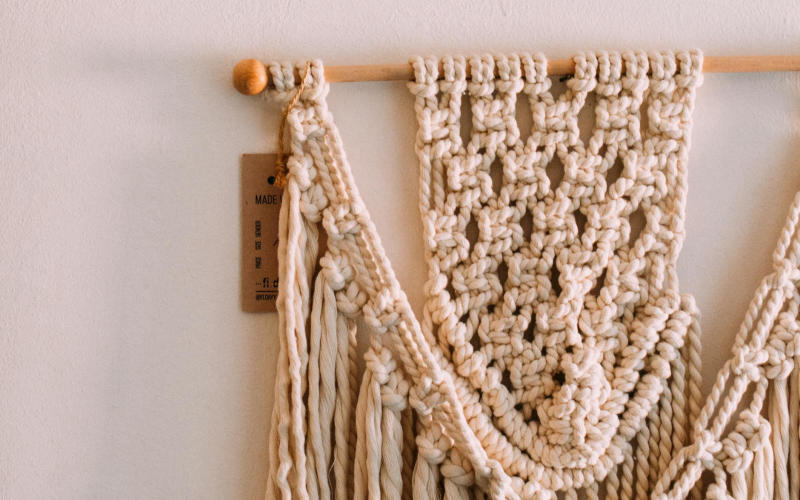

I bought my first skein of macrame cord in 2019 and just stared at it for three weeks.
No, seriously. It sat on my craft table like a silent accusation. I’d burned through maybe forty YouTube tutorials, fully convinced I needed some kind of formal fiber arts background before I could even touch the stuff. Completely wrong, as it turned out. Three weeks of being intimidated by cotton rope — wasted.
Here’s what nobody actually tells you upfront: macrame is one of the most forgiving crafts you can pick up. Knots don’t sit perfectly? That’s texture. Fringe looks uneven? Grab scissors and trim it. Most beginner macrame wall hanging projects genuinely only need two knots — the square knot and the lark’s head — and once your hands get those down, you’re basically unstoppable.
What You Actually Need Before You Start
Short answer: not much.
A wooden dowel (or honestly, a thick stick from your backyard), some 3mm or 5mm single-strand cotton cord, scissors, a measuring tape, and a comb for brushing out fringe. That’s the whole starter kit. Everything’s available on Amazon or at a craft store for under $30.
I’ve watched people drop $200 setting up their first macrame station and then never finish a single project because the supplies felt too precious to mess up. Don’t fall into that trap. Buy the cheap cord first. Save the fancy recycled cotton stuff for project number five.
1. The Simple Fringe Panel
This is project zero. The one you make before you make anything else.
Cut 20 cords at 3 feet each, fold them in half over your dowel using lark’s head knots, then just… brush out the fringe. That’s genuinely it. Hang it up. It looks intentional — good, actually, especially layered in a bathroom or bedroom corner.
Takes about 45 minutes including setup. I’ve made probably eight of these as gifts at this point.
2. The Basic Diamond Pattern
This is where most beginners hit their stride and realize macrame isn’t remotely as intimidating as it looks.
You’re using diagonal clove hitch knots to build a diamond shape in the center of your piece. The Macrame School on YouTube (they crossed 1 million subscribers in 2022, and for good reason) has a free 28-minute tutorial for exactly this pattern, walking through every single cord placement. The finished piece looks genuinely impressive — like something you’d pay $65 for at a boutique.
Cut your cords at 6 feet. You’ll want about 16 working cords for a panel roughly 8 inches wide.
3. The Boho Arch Wall Hanging
Slightly more ambitious, but still completely doable in a single Saturday afternoon.
The arch shape comes from the dowel itself — you can find curved wooden pieces made specifically for this at Etsy shops like MacrameByMar or MKnotShop, usually $8-15. Attach cords around the curve, work square knots down in a V-shape, and leave long flowing fringe at the bottom. The result is that dreamy crescent shape that’s been everywhere on Pinterest since around 2021.
Actual working time? About 3 hours. Less if you’ve already got one project under your belt.
4. The Feather Wall Hanging
Yes. The fluffy feather shape. You can absolutely make that.
Individual macrame feathers come together by knotting cord onto a wire or wooden stem, then brushing and trimming the “barbs” into shape with scissors. They’re meditative to make — genuinely calming in a way I didn’t expect from a craft, honestly. Group three or five together on a small branch and you’ve got a real statement piece.
Each feather runs maybe 20-30 minutes. A grouping of five on a driftwood branch? That’s a full Sunday afternoon very well spent.
5. The Woven Rainbow Wall Hanging
This one cheats slightly — you’re pulling wool roving into the mix — but it’s still totally beginner-friendly.
Work a flat macrame base using square knots, then weave rows of chunky wool roving across the cords in whatever rainbow order strikes you. The contrast between the structured knotted sections and the fluffy woven wool is what makes these pieces so visually alive. Fiber artist Rianne Aarts posted a version of this in 2020 that went massively viral and pretty much singlehandedly pulled rainbow wall hangings into mainstream craft culture.
Budget an extra $15-20 for a small ball of wool roving alongside your regular cord.
6. The Minimalist Single-Knot Cascade
This one looks harder than it is. That’s the whole point.
You’re alternating square knots in rows, dropping down in a chevron or cascading pattern, with long trailing cords varying in length at the bottom. All the visual depth comes from staggered knot placement — not from any complicated technique. Cut cords at wildly different lengths on purpose, some at 4 feet, some at 7, and let the fringe fall unevenly.
So good as a first project if you want something that reads as sophisticated but actually only uses one knot type.
7. The Wrapped Branch Hanging
Find a cool branch. That’s honestly half the project right there.
A gnarly, characterful branch from outside becomes your dowel — and instead of traditional knotting, you wrap sections of it in cord, attach short cascading strands, and leave stretches of natural wood exposed. The organic irregularity of the branch does a lot of the aesthetic heavy lifting for you. This style pulls from Japanese wabi-sabi philosophy, the idea that asymmetry and natural imperfection are features rather than flaws.
And it’s genuinely one-of-a-kind, because, well, it literally is.
8. The Layered Texture Sampler
Make this one when you want to actually learn technique, not just produce something pretty.
The piece intentionally works three or four different knot types in horizontal bands — square knots, spiral half-hitch knots, gathering knots, plain fringe — so you end up with a visually interesting sampler AND a wall-worthy piece AND a growing knot vocabulary all at once. Think of it as your personal cheat sheet, but hung on the wall.
And because you’re practicing across a full panel, your hands build muscle memory way faster than watching tutorials alone ever gets you.
9. The Statement Sunburst
Big. Bold. Takes a full weekend — but worth every hour.
You’ll need a large wooden ring (12-18 inches diameter, around $8-12 on Amazon) and you’ll attach cords radially, like spokes on a wheel, then work outward with square knots until the frame is filled. The finished piece has that dramatic circular form that photographs insanely well. Genuinely satisfying to complete. And it scales easily — want something bigger? Just buy a bigger ring.
Bottom Line
Something I’ve noticed after years of making these and watching other beginners: the people who actually finish projects are almost always the ones who let ugly knots stay put through at least their first two pieces. There’s this pull to undo and redo until everything is perfect, but macrame muscle memory only builds through forward momentum. Your hands learn faster from completing ten imperfect projects than from obsessing over one. Treat your first wall hanging like a sketch, not a painting — and you’ll be surprised how quickly the “sketches” start looking like finished art.
Frequently Asked Questions
How much cord do I need for my first beginner macrame wall hanging project?
A solid starting rule: cut each cord at four times your desired finished length, then double that for folded cords. For a basic 12-inch panel, cut cords at about 5-6 feet each. Buy more than you think you’ll need — leftover cord never goes to waste.
What’s the best cord thickness for beginners?
Start with 3mm or 5mm single-strand (twisted) cotton cord. It’s easier to handle than braided cord, the knots are more visible so you can actually see what you’re doing, and it brushes out beautifully for fringe. Don’t start with jute — it’s rough on your hands and genuinely harder to manipulate.
Can I really finish these projects in one weekend?
Projects 1 through 5 on this list? Absolutely doable in a single afternoon. The sunburst might eat your full Saturday and Sunday if you’re moving slowly. But “a weekend” is a realistic target for all nine of these — you’re not being sold a fantasy here.
Where do I hang macrame wall art without damaging my walls?
Command strips work surprisingly well for lighter pieces under about 2 lbs. For heavier statement pieces, use a proper wall anchor with a small nail or screw. Most macrame looks best against a light wall with some natural light hitting it — the shadows the knots cast are actually part of the visual effect.
Photo by Maria Tyutina on Pexels