

Here’s what nobody actually tells you when you Google weather stripping: most tutorials obsess over energy bills and completely ignore the fact that a 1/16-inch gap under your door is basically a welcome mat for ants, silverfish, and crickets. I found this out the hard way in 2019. Spent an entire October weekend resealing my basement door for winter—then discovered in November I’d done a sloppy job on one corner, and by spring I had a full ant highway running through it.
Weather stripping is one of those rare home repairs that genuinely solves two problems at once. Done right, you’re not just trimming your heating and cooling costs (the U.S. Department of Energy estimates gaps around doors and windows account for up to 30% of home energy loss)—you’re also shutting down the exact entry points pest control companies charge $150–$400 a visit to handle.
So let’s get into it. No fluff.
Know What You’re Dealing With First
Before you buy a single thing, spend 20 minutes doing a real inspection. Grab a flashlight and run it along the edges of every exterior door and window at night. If light bleeds through from outside, bugs can get through. Full stop.
Check the door sweep on the bottom of each exterior door separately—that’s usually the worst offender. I’ve found gaps exceeding a quarter-inch on doors that looked completely fine in normal daylight. And try this: press a piece of tissue paper against each door frame edge while the door is closed. If it flutters or slides out easily, you’ve got air moving through there.
Write down what you find. Seriously, grab a notepad. You will absolutely forget by the time you’re standing in the hardware aisle staring at sixteen different products.
Choosing the Right Weather Stripping Material
This matters more than most people realize. There are at least six common types, and they’re not interchangeable.
Foam tape (like 3M’s #5787 series) is cheap and easy, but it compresses permanently within one or two seasons and almost never creates a tight enough seal to stop insects. Fine for a quick interior window fix. But don’t use it on your main entry door if you’re serious about pest control.
V-strip (tension seal) is what I actually recommend for door frames and double-hung windows. It’s a folded plastic or metal strip that springs open against the gap. Duck Brand makes a solid vinyl version for around $8 per 17-foot roll. It lasts 3–5 years with normal use and creates a consistent mechanical seal bugs genuinely can’t squeeze past.
Door sweeps and automatic door bottoms are non-negotiable for the bottom of exterior doors. A heavy-duty aluminum door sweep with a vinyl fin—something like the M-D Building Products 07165—runs about $15–$20 and is honestly the single best investment you can make against crawling insects. Automatic door bottoms (they rise when the door opens, drop when it closes) are even better but cost $60–$120.
Silicone bulb gaskets work well for casement windows or irregularly shaped frames where V-strip won’t conform properly.
How to Install V-Strip on Door Frames
Clean the surface first. This isn’t optional—V-strip adhesive fails fast on dusty or greasy surfaces, and a failed strip is actually worse than no strip because it gives you false confidence. Wipe everything down with isopropyl alcohol and let it fully dry.
Cut to length. Use sharp scissors or tin snips for metal versions—don’t try to score and snap it, you’ll end up with uneven edges. Cut the hinge side first since that’s the trickiest fit.
Slide the V-strip into the door stop groove with the open end of the “V” facing the exterior. Press the adhesive side firmly, starting from the top and working down. On the hinge side, you’ll need to cut small notches around each hinge—about 1/8 inch of relief on each side. Skip this step and the door won’t close properly.
Test it before you do the latch side. Close the door and feel for resistance. You want it to close fully but with slightly more push than before. If it won’t latch at all, the strip is either too thick or positioned too far inward—pull it back a little.
Installing a Door Sweep to Block Ground-Level Insects
This is honestly the most satisfying part of the whole job. Ground-level entry is how the vast majority of crawling insects—ants, roaches, crickets, centipedes—actually get into your house.
Remove the door from its hinges if you can. Not mandatory, but it makes everything dramatically easier. Measure the door width precisely (not “roughly 36 inches”—measure three times if needed), and mark your sweep with a pencil line before cutting.
Drill pilot holes before you screw the sweep into the door bottom. Most packages include screws that are too short, so replace them with #8 screws at 1.25 inches. Position the sweep so the vinyl fin just barely touches the threshold when the door is closed—you want light drag, but not so much that it fights you when opening.
Here’s what most guides don’t mention: check the corners. Even a perfectly installed sweep can leave tiny triangular gaps where the door frame meets the threshold. Fill those with a thin bead of clear silicone caulk. Let it cure 24 hours before testing.
Window Weather Stripping for Insect Control
Double-hung windows are sneaky about this. Both the top sash and bottom sash need attention. Use foam tape (yes, foam is fine here—windows don’t take the same physical punishment as doors) along the top of the upper sash and bottom of the lower sash where they meet the frame.
For the meeting rail—where the two sashes overlap in the middle—use adhesive-backed pile weather stripping (the fuzzy kind). It’s specifically designed for sliding contact and won’t shred the way foam does. Look for brands like Pemko or Thermwell at local hardware stores.
Casement windows that crank open can usually be sealed with a stick-on foam or EPDM rubber bulb gasket pressed into the frame groove. Replace it every 3–4 years—rubber degrades from UV exposure faster than most people expect.
Common Mistakes That Invite Bugs Back In
Skipping the corners. Every corner is a potential gap. Caulk them all without exception.
Using indoor weather stripping on exterior applications. Indoor foam compresses fast, absorbs moisture, and offers basically nothing by summer.
And forgetting the garage door. If you have an attached garage, that bottom seal is essentially your real perimeter. A worn garage door seal can let in mice, not just insects. Replace it every 5–7 years at minimum.
Bottom Line
Here’s something I’ve genuinely never seen anyone else point out: weather stripping and pest control are almost always treated as two completely separate household budgets, but the overlap between them is enormous. A single afternoon of solid weather stripping work—maybe $60–$80 in materials total—can eliminate the specific entry points that justify the “perimeter pest control” service most exterminators push quarterly at $100+ per visit. You’re not just sealing a gap. You’re removing a revenue stream from the pest control industry. Do it right once, inspect it every fall, and you genuinely won’t need that service for most common crawling insects.
Frequently Asked Questions
How do I know if my weather stripping is actually blocking insects?
Do a flashlight test at night with all interior lights off—have someone shine a light along the exterior edge while you look from inside. Any visible light means bugs can get through. Also watch for debris or dead insects collecting near your threshold; that’s a sign they’re trying to enter and occasionally making it.
Can weather stripping stop small ants specifically?
Yes, if installed correctly. Ants can squeeze through gaps as small as 1/32 of an inch, so you need tight, uncompressed seals. V-strip and solid door sweeps handle this well. Foam tape alone usually won’t—it compresses too much at contact points and creates micro-gaps that ants find quickly.
How often should I replace weather stripping?
Door sweeps and foam tape: every 2–3 years. V-strip: every 4–5 years. Silicone and EPDM rubber: every 5–7 years. Don’t wait until you can see obvious deterioration—inspect every fall by running your finger along the seal and feeling for gaps or material that’s gone hard and brittle.
Does weather stripping work for flying insects like gnats or moths?
Not really, no. Flying insects that get inside usually come through when windows are open or through damaged screens. Weather stripping addresses the perimeter seal when doors and windows are closed. For flying insects, focus on repairing window screens and checking for gaps around any window AC units.
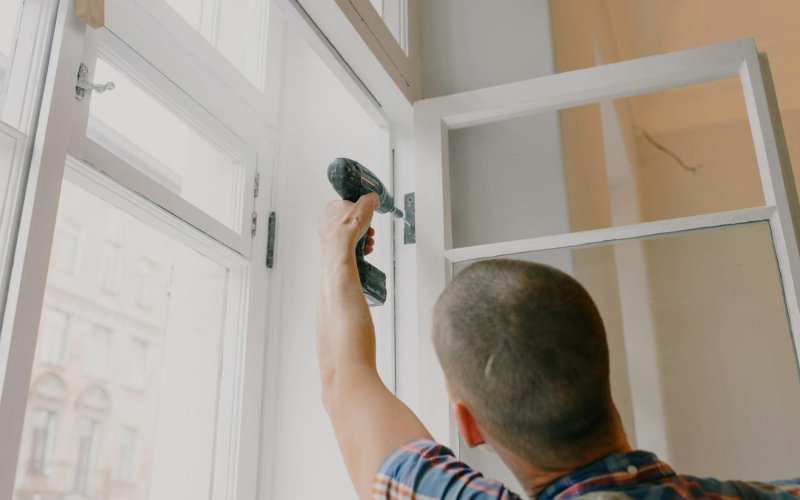
Photo by Ksenia Chernaya on Pexels